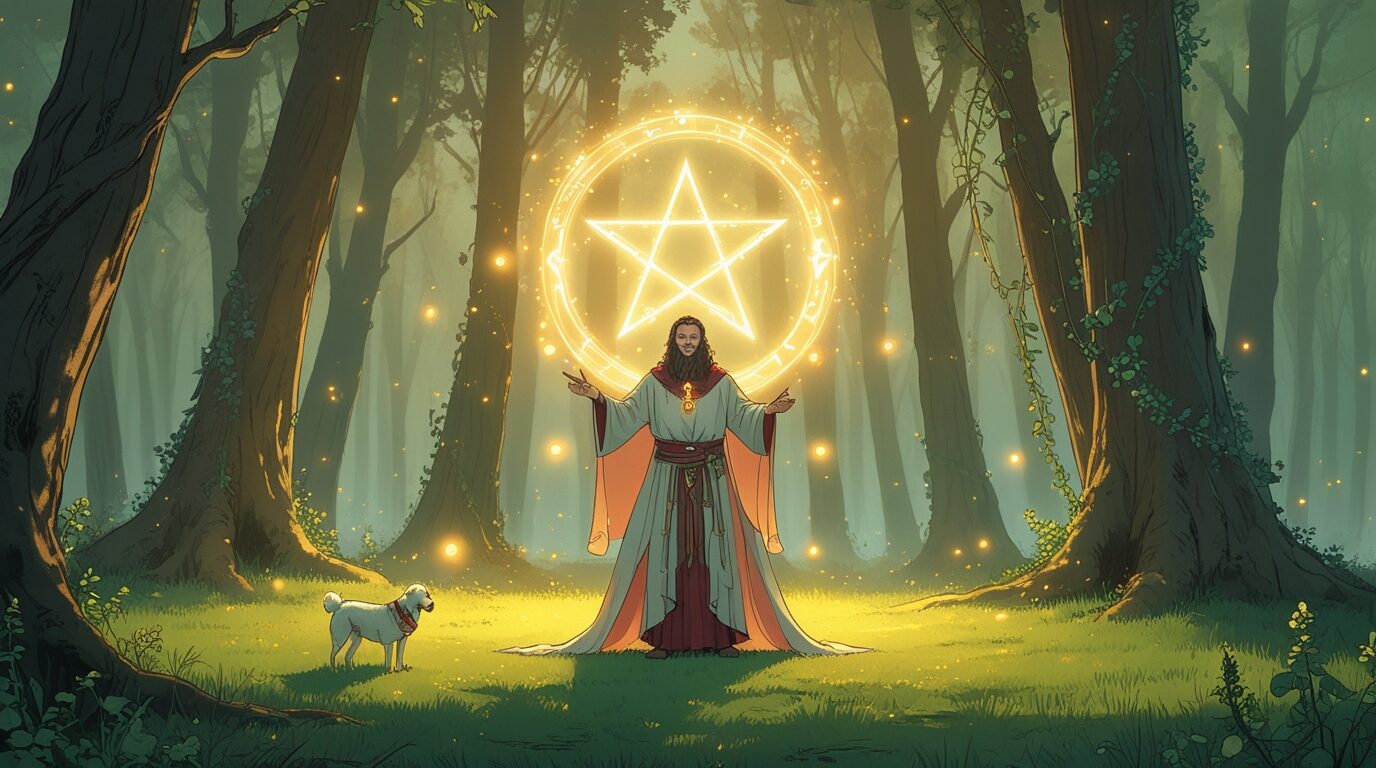
There are a great many kinds of witch. Kitchen witch, green witch, sea witch, dark witch, faery witch, goth witch. You have probably heard of some of them, and you have probably wondered where you sit.
That is the question nearly every new practitioner arrives with. What kind of witch am I? Where do I fit? How would I even know?
So let me save you the waiting. I am not going to make you sit through a video to find out.
Why witchcraft feels freeing
There are many kinds of occultist, Wiccan and pagan practitioner, and a large part of the draw is how freeing it is. Religions like Christianity, Islam and Buddhism have their own sects, and they can seem very strict in their practice. It can feel limiting, especially if you grew up inside one.
Witchcraft, paganism and Wicca offer liberation from a lot of that — from the strictness, and from the shame that often comes with being raised inside a conventional or Abrahamic religion.
Religion and belief systems have always been powerful, whether as a means of salvation or simply as an influence on the culture and politics around them. Witchcraft is liberating because it lets you find the tools that are already around you: the earth, plants, herbs, flowers, water, fire, air, and every other living thing, including yourself.
You do not need a Bible. You do not need a preacher or a priest. The tools are right there, waiting to be found and used. The power is in the practitioner, not in a book or a building.
There are many divisions of witchcraft as well, and that diversity is a good thing. It means there is something that suits a very wide range of people — which brings us back to the question.
Get your hands dirty
The best way to find out what kind of witch you are is not to read about it. It is to do it.
Look into the traditions that fascinate you and study them. Study their lore and their mythology. Think about what they offer you and what you can offer them, and see whether it feels right. I know that sounds vague. By right, I mean something like how comfortable a perfectly fitting sweater is on a cold winter night — it feels good to fit so well.
Even if it feels intimidating, or a bit frightening, get in there and immerse yourself as far as you can. You will not learn whether a practice suits you by reading theories about choosing the right practice. So the first piece of advice is simply that: get in there. Question it, grow with it, and if it does not fit, do not force it. Move on.
So what is an eclectic witch?
By this point you have tried several traditions, and you have found yourself drawn to practices from all over the place. The path for you may well be eclectic witchcraft, or eclectic Wicca.
An eclectic witch combines elements of other traditions into a path of their own. It is arguably the most liberating kind of practice there is, and for that exact reason it can seem the most intimidating. It should not. Eclectic witchcraft is far more common than you think.
To be an eclectic witch is to do witchcraft in a genuinely do-it-yourself way, made to fit you. That is a good thing, not a lazy one. By putting your own intent into a practice you make it yours, and you get out of it what you put into it. Taking the effective and positive parts of other thriving practices can strengthen your own and make it more powerful and better suited to you.
Is that just stealing?
No. Blending practices, done properly, is a fine way to bring other traditions into your own craft — but there is a great deal of difference between blindly taking symbols and ideas, and studying something properly before you use it.
So: research, research, and then research a little more. Read everything available to you. The folklore, the relevant mythology, the rituals, the traditions, and where they come from. The difference between an eclectic witch and a magpie is the work.
Coven, or on your own?
There is no or here. If you are part of a coven and most of your practice comes from that circle, good. That does not exclude solitary work. Do coven work with your coven, and spend the rest of your time doing solitary ritual at home, or wherever you are comfortable.
And if you do not feel comfortable with the idea of a coven, that is fine too. You do not need one to be a witch. You are as valid as a solitary eclectic witch as you would be inside a circle.
The doubt is normal
Impostor syndrome is very common when you are starting out. It is normal to have days when you are desperate for reassurance and find yourself searching am I a real witch? We have all been there.
But every one of us has the tools to reach witchcraft, to connect to the earth and the world around us. And the questioning itself — the seeking, the checking — is a sign you are on the right path, not evidence that you are on the wrong one.
What it looks like in practice
You might blend Vodou with Norse paganism, or juju with pre-Islamic Arabic paganism. Once you start looking, the possibilities are endless. You begin to see that life is joined together by a powerful divine energy, and that the many belief systems practised around the world have a great deal in common — and much that can be combined.
You are innovative, creative, and not satisfied with one source of information. You are curious. You want more knowledge and new ways of thinking. Mixing practices and adding new elements can bring joy into many parts of your life — psychological, philosophical, mental, social.
Witchcraft is more than a way of life. It is a living, breathing, evolving creative process.
Make it yours
You are in control of the elements you work with, and you get to choose what feeds your soul. Maybe you like tarot cards but not crystals. Maybe runes are your thing and tea leaves are not. Make it your own.
Experiment. If it works, that is wonderful. If it does not, tweak it until it does, or swap it for something else. Life is not stagnant, and your practice should not be either.
To be an eclectic witch is to make your own rules, keep your own rules, and live as you see fit. If any of this has felt familiar while you have been reading it, then I would say you probably are one. Go and try it. Experiment. Create.
And one last thing, which I have said before and will say again:
You do not need to label or classify yourself as any kind of witch if you do not want to. Having a label makes no difference to who you are or what you do.
Take the wisdom, enjoy the craft, and leave the taxonomy on the shelf if it does not help you.
Cleansing Spells & Rituals
A 39-page book of shadows: 21 rituals and spells for the home, the body and the mind. A4 and US Letter, $12.
See the book