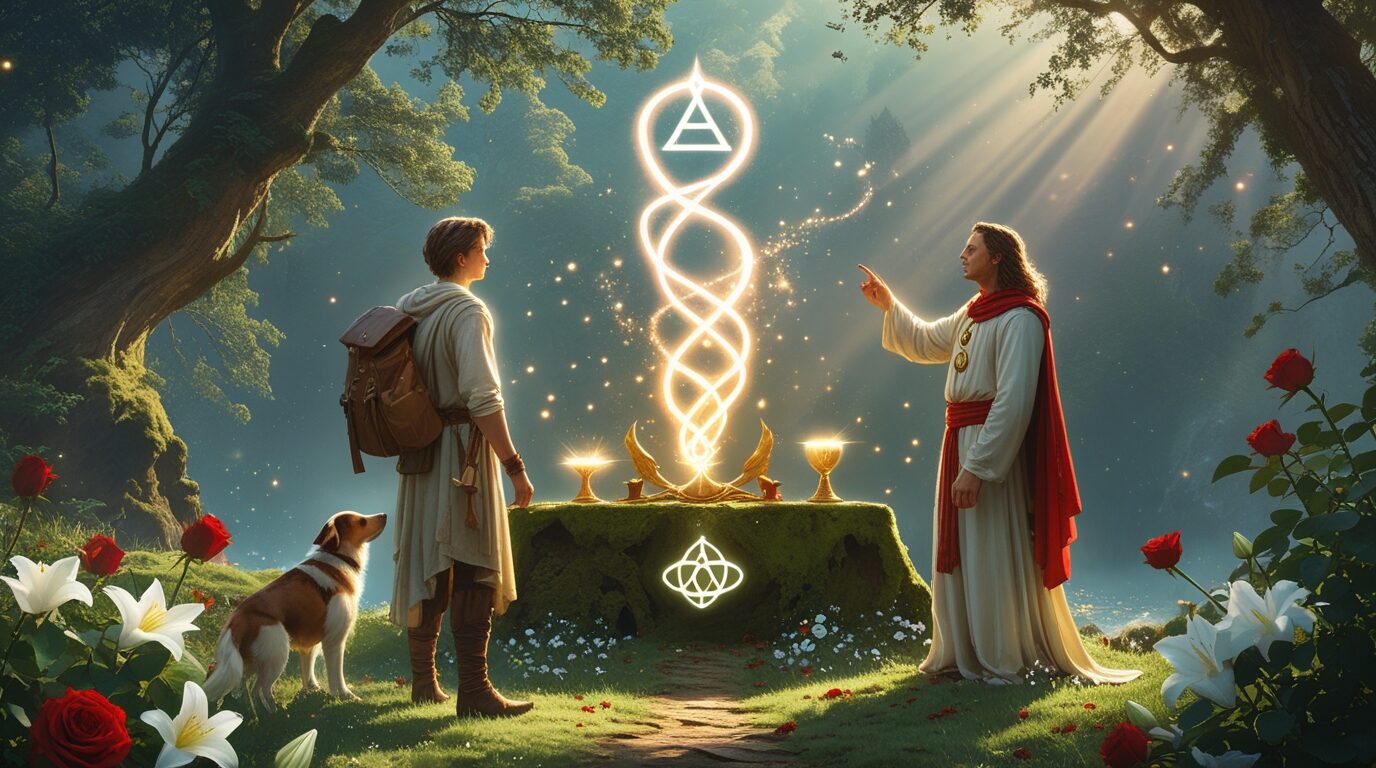
Handfasting is the oldest wedding idea most people have never heard of, and they recognise it the second they see it. Two people holding hands, a cord wound round their wrists, somebody speaking the words over them. That is where "tying the knot" comes from. It was never a figure of speech. It was a thing people did, in front of witnesses, and then went home married.
I have been a practising solitary witch for close to forty years, across more traditions than I can list in one sentence. Handfasting is the piece of the old craft that people ask me about most, usually because they are getting married and the registry office does not feel like enough.
What a handfasting actually is
It is a unity ritual. That is the proper name for the moment in a ceremony when two people stop being two separate people in front of everybody and become one thing. Some couples pour two jars of sand into one. Some light a candle each and then a third from both. Handfasting does the same job with a length of cord and their own hands, and it does it better, because there is nothing to buy, nothing to clean up, and the thing you end up with is something you can keep in a drawer for forty years.
The couple's hands are bound — the old phrase is the blessings of the hands — and the binding is the promise. Nobody signs anything. The cord is the document.
Where it comes from
Ancient Britain, somewhere around the eleventh and twelfth centuries, and from there across Europe and into a dozen other cultures. In England, from the late twelfth century into the seventeenth, "handfasting" meant engaged to be wed. The ceremony happened a year and a day before the church wedding, usually at the home of the bride's family. The place was never the point. A garden, a tavern, a kitchen with the table pushed back against the wall. What mattered was that people were there.
England ended it in 1754 with the Marriage Act, which pulled marriage into the parish register and made anything outside it irregular. Scotland did not follow. Marriage by declaration stayed lawful there long after it had stopped being lawful in England, which is why the custom survived at all — north of the border, tying the knot still had teeth. Plenty of couples did both: the church for respectability, the handfasting for themselves.
The Celtic tradition came to call it a temporary marriage. A year and a day, and then a choice.
The year and a day is not a trial run
You will read, in a hundred wedding articles, that a handfasting is a trial marriage. A year to see how it goes, with a way out at the end. I do not hold with that reading, and I think it gets the whole thing backwards.
A year is not hard to get through. Anybody can be charming for twelve months. What is hard is the year somebody loses their job, or the year a parent dies, or the decade after the children arrive when neither of you has slept properly since the last one.
But I understand why the year is in there. A lifetime is a very large thing to say out loud in a room full of people, and some couples cannot honestly say it. They can say a year. And once you have said a year, out loud, on purpose, in front of the people who matter to you, you have done the difficult part. Breaking a marriage down into pieces is not an escape clause. It is how the thing actually gets done: an hour at a time, a day at a time, a year at a time, and then you look up and it has been thirty years.
The cord, and what goes into it
A handfasting cord is a ribbon, or a length of silk, or a piece of cloth with a history. It wants to be about one to two metres — six and a half feet or thereabouts — long enough to turn, twist and loop around two pairs of wrists without anyone having to hold their breath.
What matters is what it is made of. Couples use a ribbon in the wedding colours, a strip of a grandmother's scarf, cloth from a country that means something, or something they dyed themselves in the garden. That is not decoration. It is the difference between a prop and an object with a life in it. After the ceremony the cord comes off their hands and goes into a box, and forty years later it is still the thing from that day that survived.
Some couples use one cord for the whole binding. Some use a separate cord for every promise, so that the binding is built out of the vows themselves. Both work. The second one is slower and heavier, and it looks extraordinary when it is done.
The colours are usually chosen for what they mean to the two people under them, which is the only meaning that holds. For what it is worth, this is the list most people work from:
- Red — passion, lust, fertility
- Orange — encouragement, attraction, plenty
- Yellow — charm, joy, balance
- Green — money, fertility, prosperity
- Blue — tranquillity, devotion, sincerity
- Purple — power, piety, sentimentality
- Pink — unity, honour, happiness
- White — purity, meditation, peace
- Silver — treasure, values, inspiration
- Gold — energy, intelligence, longevity
- Grey — neutrality, cancelling, balance
- Brown — earth, grounding, home
- Black — strength, vision, success
Use it as a starting point, not a rule. A colour that means nothing to the couple is a colour somebody chose off a website, and the cord will feel like it too.
What happens during the ceremony
The shape of it has not changed much in eight hundred years.
- The officiant tells the couple, and the guests, what is about to happen. Half the room has never seen this before and deserves to know what they are watching.
- The couple join hands — right hand to right hand, clasped, so that the hands sit together in the middle.
- The cord is wrapped around their joined hands, usually a few turns, and tied. Not tight. Nobody needs a tourniquet for a wedding.
- The officiant speaks the blessings and reads the traditional promises, and the couple answer.
- With their hands still bound, the couple say their own vows to each other, and exchange rings if they have them. The binding stays on through all of it, which is the point — they make the promises with their hands already tied.
- The cord comes off. The couple keep it.
Some old cultures left the couple's hands bound for the first thirty days of the marriage. Only two of the four hands, so that they could still eat. How is that for a real commitment?
Who can perform one
Anyone the couple approves of. A priest or priestess, if they have one. A friend, a mother, a brother who is good at talking in public. I have known couples ask the person who introduced them, which I thought was the right answer.
Handfasting is not a religious activity in the sense that a church means it, but it comes out of pagan and Celtic practice, and it carries a fair amount of the old energy with it. Nothing about it needs a licence, a robe or a qualification. If the couple says you can do it, you can do it.
Is it a legal marriage?
No. Not in the United Kingdom and not anywhere that I know of. In Scotland, marriage by declaration survived into the twentieth century before registration law finally closed it, and even there the handfasting was never the legal event on its own. A handfasting does not register you, does not appear on a certificate, and does not need a registrar in the room.
What that means in practice is that you do both. Couples book the register office for the legal part — often quietly, on a weekday, with two witnesses — and hold the handfasting at the weekend with everybody they love in the room. The paperwork is done. The marriage is the other thing.
It also means the ceremony has been used by couples who could not marry in law: same-sex couples before that was legal here, and couples in countries where it still is not. A ceremony that requires nobody's permission is useful for exactly that reason. Nobody in that circle is there to approve the match. They are there to support it.
The circle
At a handfasting, the guests usually stand in a circle around the couple rather than sitting in rows, and they hold hands once the circle is closed.
Two things happen when you do that. The first is that there are no sides, no front row, no seat at the back for the cousin nobody talks to. Everybody in that circle is the same distance from the couple, and everybody is holding on to somebody. It is the least hierarchical thing you can do at a wedding.
The second is the old one: a closed circle is a container. The energy raised inside it stays inside it, and the couple stand in the middle of a room full of people wishing them well. Whatever you believe about energy, being surrounded like that does something to a person.
Some traditions walk the circle clockwise — deosil — when they cast it, and some go the other way. Follow the one you were taught, or the one that feels right in the room, and do not let anybody tell you afterwards that the ceremony failed because the circle went round the wrong way.
It also makes it considerably harder for the couple to change their minds and run.
Why couples still choose it
Because it is the one part of the day that asks nothing of anybody. No venue, no licence, no approval, no script written by a committee. Two people, a cord, and the people they love standing around them in a ring.
And because it does not pretend. A handfasting does not require you to say that this will last forever, or that nothing will ever go wrong, or that you will feel the same in twenty years. What it asks is that you choose each other today, out loud, and mean it, and then choose again tomorrow. That is an honest promise, which is a rarer thing at a wedding than it should be.
There is something else, and it is harder to put down on paper. This ritual is old enough that our ancestors stood in the same shape, saying the same kind of words, with their hands bound the same way. Whatever you think about that, it is not nothing. You are joining a queue that has been standing in that circle for a very long time.
If you are still working out where you sit inside all of this — the traditions, the labels, which of them you are allowed to use — I wrote about that separately in Am I an eclectic witch?. And if you are the one holding the ceremony, and you would rather not be a wreck by the time you get to the promises, Grounding, centering and shielding is the half hour of work worth doing before you stand up.
A ceremony you can use
This is the version I would hand to a couple who asked me to write one. Change the words. The words were never the magic — the hands and the witnesses are.
The couple stand facing each other, right hands clasped. The officiant holds the cord.
Welcome. Thank you all for being here today — those of you in the room, and those joining us from wherever you are. Today is a good day. Today [Name] and [Name] are declaring their love for each other by joining hands and making their promises in front of you. They have chosen something old to do it with. They are going to be handfasted.
What it is. Handfasting is an older tradition than the churches that came after it, and it belongs to more than one culture. Pagans were handfasted for a year and a day. I know how that sounds — a year, and then you are free. But think about what is actually being asked. Two people, standing up in front of the people who matter to them, choosing each other on purpose, out loud. A lifetime is a difficult thing to promise. A year is a thing you can do. And then you do another one.
The cord. What we are using is a cord that [Name] and [Name] made themselves. They put thought into it. It binds them today, and afterwards it goes home with them, and it stays in their house for the rest of their lives.
The officiant wraps the cord around their joined hands.
The hands. In the old days there were no rings to exchange. The joining was the hands, crossed like this, and the shape the two hands make together is the shape of infinity. May your love for each other be the same — without a beginning and without an end — and may you draw on the love that moves through everything to keep it going.
The promises. I ask you both:
- Do you promise to be there for each other when you need each other?
- Do you promise to fill each other's days with sunshine?
- Do you promise to comfort each other?
- Do you promise to encourage each other?
- Do you promise to help each other reach your goals?
- Do you promise to be best friends, always?
- And do you promise to love each other with all your hearts?
Each answered: We do.
The blessing. May the words you have spoken here stay with you for the rest of your lives, and mean more to you as the years go on. Through the triumphs and the difficult stretches, through plenty and through want, through sickness and through health. May you keep bringing everything you have into this marriage, and may you keep being filled up from the source of love itself.
The untying. Some old cultures left the couple's hands bound for the first thirty days of the marriage — only two of the four hands, so they could still eat. How is that for a real commitment?
The officiant removes the cord.
I take this cord off your hands. May what it means stay with you always.
The closing. Now you will feel no rain, for each of you will be a shelter to the other. Now you will feel no cold, for each of you will be warmth to the other. Now there is no loneliness, for each of you is a companion to the other. You are two people, and there is one life in front of you. May your days be good and long upon the earth.
By joining hands and looking at each other, let it be known that you are joined, body and soul, in this life, and that this bond is sacred and eternal. I witness it, and I affirm it, and it gives me great pleasure to tell everybody here that you are — and will keep on being — partners for life.
You are married. You may kiss.
A note on that closing blessing: it is usually printed as an Apache wedding blessing, and it is not one. It comes from a novel published in the 1940s. Nobody has ever minded, including me, and it is still the best closing there is.
After the cord comes off
Keep it. Do not put it in a box in the loft with the photographs; put it somewhere you will see it. Mine is the only piece of anybody's wedding that is worth looking at twenty years later, because it is the only piece that was handled by the people making the promises.
And if you are not pagan, and you are reading this because a couple you love has asked you to hold the cord for them, that is the whole ceremony. You do not need to believe anything. You need to stand up, hold a piece of cloth, and say what you actually mean about two people you are fond of. The rest of it has been working without us for eight hundred years.
Cleansing Spells & Rituals
A 39-page book of shadows: 21 rituals and spells for the home, the body and the mind. A4 and US Letter, $12.
See the book